
The standard Tuberculin skin test is known as the Mantoux test. This is used as a screening test for tuberculous infection or disease and as an aid to diagnosis. A small amount of tuberculin protein will be injected just into the skin on the forearm. The reaction to this is then measured 2-3 days later and a decision as to whether a BCG vaccination is required is then made by our trained nurses.
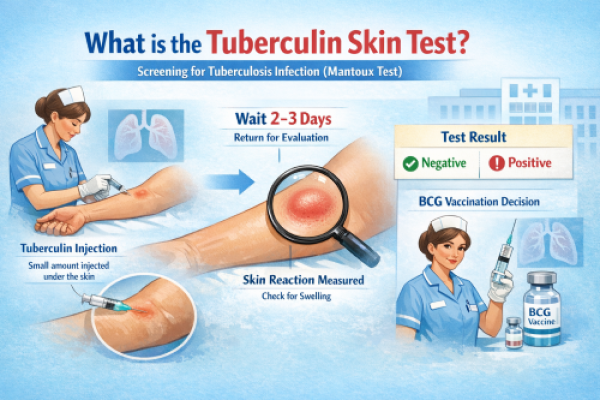
BCG vaccination will be offered to those with a negative Tuberculin skin test.
It is likely that the test would need to be repeated
BCG is a vaccine used to increase resistance to tuberculosis. It is not a cure for the disease. The vaccine contains live attenuated (treated) bacteria of the type called Mycobacterium bovis.
Most literature suggests that BCG is 70-80% effective at protecting individuals against Tuberculosis
Most literature suggests protection lasts at least 15 years during which time protection is likely to be boosted by contact with similar bacteria in the environment to give longer protection. National guidance recommends that the vaccination is only given once in a lifetime.
Millions of babies, children and adults throughout the world have been vaccinated with BCG without ill effects.
A small amount of vaccine is injected just into the skin of the left upper arm.
Immediately after the BCG vaccine there is a small swelling at the site of injection. Virtually everyone (90-95%) who has a BCG vaccination will develop a raised blister at the site of injection approximately 10 days to 2 weeks later. This is normal and nothing to worry about.
This may grow into a circle up to 7mm in diameter and may become crusty where fluid collects and a small ulcer may form. The ulcer heals by forming a scar. This healing process usually takes 2-6 weeks but can take up to 3 months in some cases. No other vaccinations should be administered into the left arm for 3 months following BCG vaccination.
The injection site should not be rubbed or scratched or pressed. Normal showering/bathing is fine.
No plasters, creams or lotions should be applied.
If you have any concerns or if you have any signs of infection at the site e.g. hot/swollen/ red and painful, please contact your GP.
There is no restriction on taking part in any sports following vaccination. If the site is cracking and oozing, apply a waterproof dressing over the site while swimming or bathing/showering but the plaster should be removed immediately afterwards.
Headache or mild fever after vaccination is unlikely but possible. A paracetamol-based product can be taken if necessary. In very rare cases, an excessive response to BCG vaccination may result in a discharging ulcer at the site of the vaccination that requires a course of antibiotics to treat.

Recent Comments